


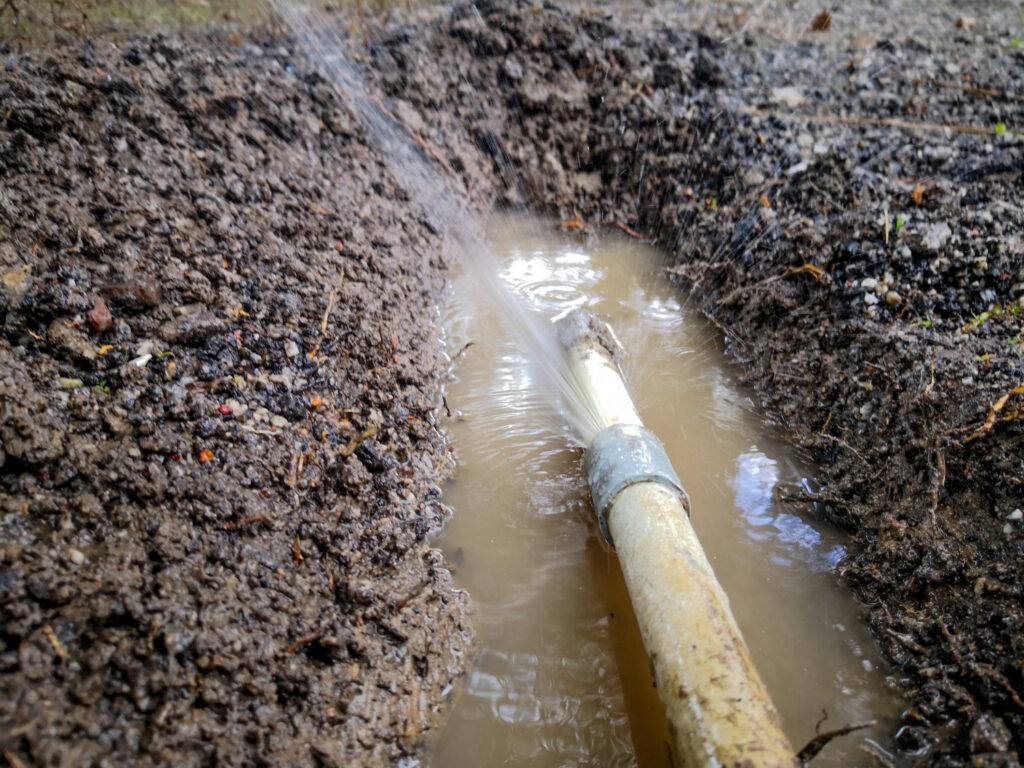
Plumbing leak detection is how a licensed plumber locates water escaping from a supply line, drain line, or fitting before that water causes damage that far exceeds the cost of the repair itself. In North Pole, where pipe systems contend with sustained freeze cycles, temperature-stressed joints, and crawl spaces that are difficult to inspect regularly, hidden leaks have more places to hide and more time to cause damage before they become visible. A stain on a ceiling or a soft spot in flooring rarely appears the same week the leak begins.
In this article, you’ll learn why the leaks that cost the most are the ones that go undetected longest, how cold-weather conditions in Interior Alaska create specific vulnerability patterns in residential pipe systems, why opening walls without detection equipment is a costly approach, and what early leak detection protects beyond the pipe itself.
Here’s what you’ll find below.
- The most expensive leaks are often the ones you cannot see
- Cold weather turns minor pipe problems into bigger risks
- Guessing where to open a wall gets expensive fast
- Early detection protects more than the plumbing line
Keep reading to understand how hidden leaks develop in North Pole homes, how professional detection equipment changes what a plumber can find without destructive access, and why the timeline between leak onset and repair matters more than most homeowners realize.
The most expensive leaks are often the ones you cannot see
A visible leak at a fixture or an exposed fitting is a problem with a clear location and a straightforward repair path. The leaks that produce the largest repair bills are the ones that release water slowly into a wall cavity, a subfloor assembly, or a crawl space for weeks or months before any surface evidence appears.
A small pressure change can point to water leaving the system somewhere
Static water pressure in a residential supply system should remain stable when no fixtures are in use. A system that loses pressure gradually over minutes or hours while all fixtures are closed is releasing water somewhere in the distribution network. The loss may be small enough that no wet surface is ever visible from inside the home, particularly if the leak point is in a location where water absorbs into insulation, dissipates into soil beneath a slab, or drains away through a crawl space before pooling.
A pressure test is one of the first diagnostic steps in a professional leak detection assessment. The plumber isolates sections of the supply system and monitors pressure over a defined period. A section that holds pressure confirms integrity. A section that loses pressure narrows the search zone to that portion of the pipe network. This step alone can eliminate the need to open walls in large portions of the home.
Homeowners can perform a basic version of this check themselves using the water meter. With all fixtures and appliances off, the meter should show no movement. A meter dial that continues advancing indicates active water consumption somewhere in the system, which is confirmation that a leak is present even before any physical evidence appears inside the home.
Wall stains and soft flooring may appear after the leak has spread
The surface evidence of a hidden leak, such as a discolored patch on a ceiling, a bubbling section of paint on a wall, or a section of flooring that has developed a soft or springy feel underfoot, appears only after the surrounding materials have absorbed enough moisture to show a physical change. That process takes time. By the appearance of the first visible stain, the moisture has already traveled from the leak point through insulation, framing members, or subfloor sheathing to reach the finish surface.
What that sequence means in practical terms:
- The stain location is rarely the leak location. Water travels along framing, down rafters, or through insulation before it reaches a surface where it becomes visible.
- The volume of water that has already entered the structure is substantially larger than the stain size suggests.
- The materials between the leak point and the visible stain are already compromised, even if they appear intact from the outside.
- Tracing the stain back to the actual pipe source requires following the moisture path, not simply looking directly above or behind the visible mark.
Professional detection confirms the pipe source before any wall access is attempted, which prevents opening sections of wall in the wrong location and limits the demolition footprint to what is necessary.
A rising water bill can be the first clue in a hidden failure
A leak that releases water at a rate below what produces visible surface damage can still move enough volume over a billing cycle to appear in the utility statement. A supply line pinhole leak at 0.1 gallons per minute, for example, releases approximately 144 gallons per day, or more than 4,000 gallons per month. That volume will show up on a water bill as a significant unexplained increase even if no wet surface is ever visible inside the home.
According to the U.S. Environmental Protection Agency’s WaterSense program, household leaks account for nearly 1 trillion gallons of water wasted annually across the United States, with a significant portion attributable to hidden supply line failures that go undetected for extended periods. The EPA recommends comparing current water use against the same billing period in a prior year as a baseline check for hidden losses.
For North Pole homeowners on a private water line, a rising well pump cycle frequency can serve the same diagnostic function as a rising water bill — the pump is running more often because the system is losing pressure between uses, which points to an active leak somewhere in the supply network.
Cold weather turns minor pipe problems into bigger risks
Interior Alaska’s freeze cycles do not just create the risk of burst pipes. They create a pattern of cumulative joint stress that weakens connections over multiple seasons before any failure becomes visible.
Freeze stress can weaken joints before a pipe fully bursts
When water inside a pipe freezes, it expands with a force sufficient to deform copper, crack cast iron, and separate soldered or compression fittings from their seats. A pipe that survives a freeze event without bursting has still experienced that mechanical stress. The fitting that held through one freeze may have a micro-fracture at the solder joint or a slightly loosened compression sleeve that will weep slowly during the next high-pressure period.
This failure pattern is distinct from an acute burst and is harder to detect because the leak rate is low and intermittent. The joint may seal under low static pressure and release water only when system pressure spikes during peak morning demand. It may also release water only when the pipe is in a specific temperature range, producing a leak that appears and disappears without apparent cause.
Common post-freeze joint failure points in North Pole homes include:
- Soldered copper fittings in uninsulated exterior wall cavities
- Compression fittings on supply lines running through unconditioned crawl space areas
- Push-fit connectors in locations that experienced freeze movement and shifted slightly out of full engagement
- PEX crimp rings on tubing that cycled through freeze and thaw without being fully protected
A plumber using acoustic detection equipment can identify a weeping joint that produces no surface evidence and no measurable pressure loss at the meter level, because the equipment amplifies the sound of water movement at the pipe wall to a level that is distinguishable from background noise.
Crawl spaces hide leaks until moisture reaches living areas
Crawl spaces in North Pole residential construction vary considerably in configuration. Some are conditioned and insulated at the walls. Some are vented and uninsulated. Many fall somewhere in between, with partial insulation at the floor joist bays and inconsistent vapor barrier coverage at the ground surface. In any of these configurations, a leaking supply or drain line in the crawl space can release water for an extended period before the moisture migrates upward into the subfloor assembly or becomes detectable in the living space above.
A crawl space leak that drains to bare ground below the vapor barrier may never produce a ceiling stain or a soft floor. It will, however, raise the ambient moisture level in the crawl space, promote wood decay in the floor joist system, and in some cases saturate enough soil to affect the moisture content of the above-grade wall framing through capillary action.
Moisture meter readings taken at the subfloor sheathing and floor joist surfaces during a leak detection assessment can identify elevated moisture content before structural deterioration becomes visible or measurable from above. This is one of the diagnostic steps that distinguishes a professional plumbing inspection from a surface-level visual check.
Thawing pipes can reveal damage that stayed quiet for days
When a pipe that has been frozen begins to thaw, the ice plug that sealed the leak point melts away and active water flow begins. In many cases, the pipe was frozen for days before the homeowner was aware of it, and the freeze damage at the failure point had already occurred. The thaw event does not create the damage. It reveals it by restoring pressure and flow to a pipe that can no longer contain them.
The practical challenge this creates is that thawing pipe damage can appear suddenly and in large volume. A fitting that separated slightly during freezing and was sealed by the ice will release the full system supply pressure the moment the ice clears. The homeowner who had no visible leak during the freeze period now has an active release that may be inside a wall or below the floor.
Emergency response to thawing pipe damage involves locating the main shutoff first, then beginning leak detection to identify all affected sections before any repair work starts. Addressing only the most visible release point without confirming whether additional weakened joints exist elsewhere in the same pipe run is a common error that leads to repeat calls within days of the initial repair.
Guessing where to open a wall gets expensive fast
Opening drywall or subfloor to find a leak without prior detection work is an approach that almost always costs more than the detection itself and frequently misses the actual leak location on the first attempt.
Leak detection narrows the search before demolition starts
A plumber arriving at a home with a suspected hidden leak has several detection tools available before any wall access is necessary. Used in combination, these tools can identify the leak location within a range accurate enough to limit the opening to a single access panel rather than a multi-foot section of finished wall.
The standard detection sequence for a suspected hidden supply line leak:
- Pressure isolation test to confirm which section of the supply system is losing pressure and eliminate branches that are holding.
- Acoustic listening along the pipe route using electronic amplification equipment to identify the specific point producing the sound signature of a pressurized release.
- Thermal imaging where surface conditions allow, to identify temperature anomalies in the wall or floor surface caused by evaporative cooling at the wet area.
- Moisture meter probing at accessible surfaces near the suspected zone to confirm elevated moisture content and map the spread pattern.
- Targeted access at the confirmed detection point, sized to allow repair without unnecessary demolition beyond what the repair requires.
Each step reduces uncertainty. By the time a plumber is ready to open the wall, the location is confirmed rather than estimated.
Listening equipment and moisture checks tell different parts of the story
Acoustic detection equipment and moisture meters answer different questions, and a thorough leak detection assessment uses both. Acoustic equipment locates where water is actively moving under pressure. It identifies the pipe segment and the approximate point along the segment where the release is occurring. It works best on pressurized supply lines where the leak is active and producing a detectable sound signature.
Moisture meters identify where water has traveled after leaving the pipe. They measure the moisture content of building materials, including drywall, wood framing, insulation, and subfloor sheathing, and can map the spread pattern of the moisture away from the leak point. That map is what tells the plumber and the homeowner how far the water has traveled and which materials will need to be addressed as part of the repair and remediation.
Used together, the two tools answer the full diagnostic question: where is the water coming from, and where has it already gone.
Finding the leak path matters as much as finding the wet spot
The wet spot visible on a surface is a symptom. The leak path is the sequence of building materials and cavities through which water traveled from the pipe to the visible surface. Understanding the path is necessary for two reasons: it confirms the actual pipe source rather than a secondary wet point, and it identifies which materials between the source and the surface have been compromised and need to be addressed.
A common example in North Pole homes with frozen and burst pipe histories is a ceiling stain in a first-floor room that traces to a pipe failure in the exterior wall of a second-floor bathroom directly above. The water traveled horizontally along a top plate, dropped through an electrical penetration in the wall cavity, and pooled against the first-floor ceiling drywall. The visible stain is several feet from the actual pipe source. Opening the ceiling directly below the stain finds wet insulation but not the pipe. Opening the exterior wall in the bathroom above finds the pipe.
Detection work that maps the path prevents this sequence of missed access and unnecessary demolition.
Early detection protects more than the plumbing line
A hidden leak that is repaired quickly produces a plumbing repair bill. A hidden leak that is discovered after weeks or months of undetected moisture migration produces a plumbing bill plus structural repair, insulation replacement, and potentially mold remediation.
Moisture can damage insulation, flooring, and framing
Water that enters a wall cavity or subfloor assembly does not stay in one place. It follows gravity and capillary action through insulation batts, along wood grain in framing members, and between layers of subfloor sheathing. Each material it contacts absorbs moisture and begins to degrade.
The materials most commonly affected by hidden leaks in North Pole homes and their typical damage thresholds:
- Fiberglass batt insulation: Loses thermal resistance when saturated and compresses permanently, reducing R-value even after drying.
- OSB subfloor sheathing: Begins to swell and delaminate at moisture content above approximately 19 percent, which produces the soft or springy feel homeowners notice underfoot.
- Dimensional lumber framing: Sustains surface mold growth at moisture content above 19 percent and structural decay at sustained levels above 28 percent, per U.S. Forest Service research on wood decay thresholds.
- Drywall: Becomes structurally compromised when saturated and serves as a growth substrate for mold spores within 24 to 48 hours of sustained wetness.
Early detection limits the volume of material affected and the scope of the repair that follows.
Mold risk grows when a leak stays trapped behind finished surfaces
A finished wall cavity is a low-ventilation environment with organic material surfaces, moderate temperatures, and, if a leak is present, a sustained moisture source. Those conditions meet the basic requirements for mold colonization. According to the U.S. Centers for Disease Control and Prevention, mold growth in residential environments is directly linked to moisture intrusion events that are not resolved promptly, and remediation costs increase substantially when mold has colonized structural materials rather than only surface finishes.
The timeline from a leak onset to active mold colonization in a wall cavity depends on temperature, material type, and moisture level, but 48 to 72 hours is the commonly cited threshold for surface mold growth on wet drywall under typical interior conditions. A leak that has been present for weeks before detection has almost certainly produced mold growth in the wet zone, which means the repair scope expands to include remediation in addition to pipe and material replacement.
Prompt leak detection is the most effective way to prevent that expansion of scope. A plumber who identifies and repairs a supply line leak before the surrounding materials are fully saturated limits the repair to the pipe and the immediate access area.
Fast repair decisions depend on knowing the source, not just the symptom
A homeowner who finds a water stain, damp flooring, or an unexplained pressure drop has a symptom without a diagnosis. Acting on the symptom by opening the most obvious section of wall is a starting point, not a strategy. It may find the problem, or it may find only the wet travel path while the actual pipe source remains untouched and active.
The repair decisions that follow leak detection, including which pipe section to access, whether to repair or reroute the affected line, and how much of the surrounding material needs to be removed, all depend on a confirmed source location. Without it, each decision carries the risk of addressing the wrong thing and leaving the real problem in place.
A plumber equipped for professional leak detection arrives with the tools to confirm the source before committing to any access, which means the repair that follows is targeted, correctly scoped, and does not need to be repeated because the wrong section was opened.
Conclusion
Plumbing leak detection in North Pole is not a luxury service reserved for complicated situations. It is the diagnostic step that determines what a repair actually needs to address, how much of the surrounding structure has been compromised, and whether the materials adjacent to the pipe need remediation in addition to replacement. Skipping detection and opening walls based on surface evidence is consistently the more expensive path, both in demolition cost and in the probability of missing the actual source.
Interior Alaska’s climate adds urgency to this. Freeze-stressed joints, crawl spaces that are difficult to monitor, and the rapid damage escalation that follows a thaw event all mean that undetected leaks in North Pole homes compound faster than in milder regions. The gap between a small repair and a large one is almost always a matter of how quickly the source was confirmed and corrected.
If you are seeing stains, feeling a soft spot underfoot, or watching your water bill climb without explanation, contact Prospector Plumbing to have a licensed technician perform a professional leak detection assessment before the damage spreads further.